
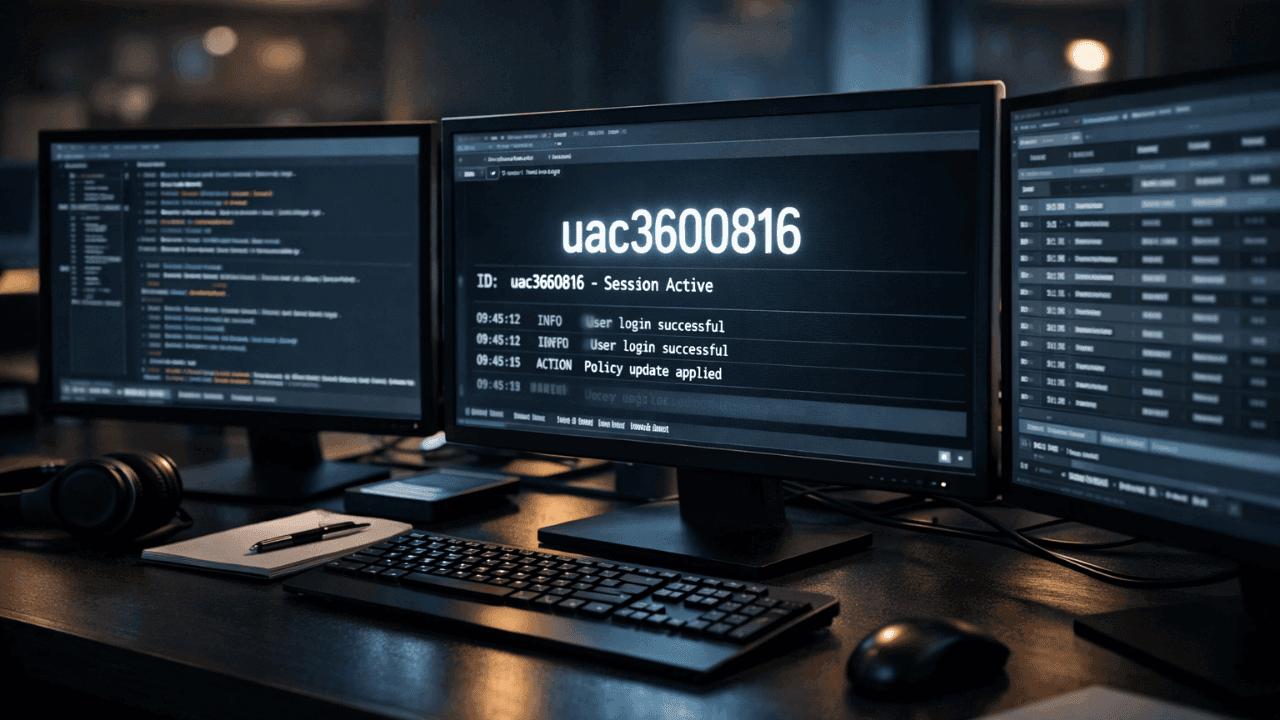
uac3600816 doesn’t announce itself politely. It shows up in logs, dashboards, exports, or background system records without explanation, and that’s exactly why people get uneasy about it. Anything that looks structured but unexplained triggers suspicion. The problem isn’t the presence of uac3600816. The problem is how little most systems bother to explain what they surface to users who aren’t meant to see the machinery.
What follows isn’t a glossary-style breakdown. It’s a practical look at how uac3600816 behaves inside real systems, why it keeps appearing across unrelated platforms, and what its presence actually signals when you encounter it in the wild.
Where uac3600816 Tends to Appear and Why That Matters
The environments where uac3600816 appears tell you more than the string itself. Patterns matter more than labels.
System logs are the most common place. Background services generate identifiers constantly to keep events traceable. When something needs to be referenced later—an access attempt, a configuration change, a triggered rule—it gets tagged. uac3600816 fits cleanly into that behavior. It shows up because the system expects to reference the same thing again without ambiguity.
Administrative dashboards come next. When platforms expose internal activity to admins, they often leak identifiers that were never meant for human interpretation. uac3600816 tends to surface here when filtering, exporting, or auditing data. The identifier isn’t for you. It’s for the system to stay consistent while you move data around.
Data exports and reports are another hotspot. CSVs and automated reports don’t clean up after themselves. They dump raw references because stripping them risks breaking traceability. If uac3600816 appears in a report, it’s usually there to preserve internal continuity, not to communicate meaning.
The takeaway is simple: uac3600816 shows up where systems prioritize accuracy over readability. That alone should calm most concerns.
Why uac3600816 Is Often Mistaken for an Error or Threat
People associate unfamiliar codes with failure states for good reason. Error messages have trained users to fear strings that look out of place. uac3600816 benefits from none of that context, so it gets lumped into the wrong category.
Actual error codes tend to behave differently. They repeat under failure conditions. They correlate with broken functionality. They come with timestamps that line up with problems users notice. uac3600816 doesn’t follow that pattern. It often appears quietly, once, and never interferes with anything visible.
Security scares follow the same logic. Anything opaque becomes suspicious. But uac3600816 doesn’t behave like malicious artifacts do. It doesn’t replicate. It doesn’t alter behavior. It doesn’t trigger alerts on its own. It just sits there as a reference point.
If you’re looking for a rule of thumb, this one holds up: identifiers that do nothing on their own are rarely the problem.
The Role uac3600816 Plays in System Organization
Modern systems don’t trust names. Names change. Labels get edited. Human-readable descriptions drift over time. Internal identifiers don’t.
uac3600816 functions as an anchor. Once assigned, it allows a system to link actions, records, and outcomes without relying on mutable text. That’s especially useful in environments with permissions, access reviews, or automated policies.
Consider access control scenarios. A permission change needs to be auditable months later. The system can’t rely on a display name that might have been renamed. It relies on a fixed reference. uac3600816 fits that role cleanly, even if the user-facing label disappears.
This is also why attempts to “clean up” identifiers often backfire. Removing uac3600816 from outputs might make things prettier, but it also removes the thread that ties actions together across time.
Why Systems Don’t Hide uac3600816 Better
This is where design trade-offs show up. Engineers optimize for system integrity first. User comfort comes later, if at all.
Hiding identifiers like uac3600816 requires translation layers. Translation layers introduce risk. They break when assumptions change. They create edge cases where the wrong thing gets referenced. For internal tools and admin-facing systems, many teams accept rough edges instead of added complexity.
There’s also a transparency argument. Surfacing raw identifiers allows power users to correlate events across systems. When uac3600816 appears consistently, it becomes a breadcrumb. Remove it, and debugging turns into guesswork.
The cost is confusion for casual users. The benefit is stability for everyone else. Most platforms choose stability.
How uac3600816 Travels Across Systems
One reason uac3600816 feels uncanny is that it can appear in more than one place. That’s not coincidence. That’s how interconnected systems work.
When a primary system generates an identifier, downstream tools often inherit it. Logging platforms ingest it. Analytics tools store it. Reporting layers echo it back. By the time you see uac3600816 in three different contexts, it feels like it’s following you.
In reality, it’s just doing its job. Consistency across systems depends on shared references. Breaking that chain creates data silos. uac3600816 survives because it keeps systems aligned.
This is also why searching for it sometimes leads to scattered discussions. Different users saw the same pattern in different tools and assumed it was something new, when it was just the same identifier passing through different lenses.
When uac3600816 Is Worth Investigating
Most of the time, uac3600816 is informational noise. Sometimes, it’s a clue.
If uac3600816 appears repeatedly in failure contexts, that’s when attention is warranted. Not because the identifier is bad, but because it’s attached to something that is failing. The identifier becomes useful precisely because it stays consistent while everything else breaks.
The same applies during audits. If a questionable action traces back to uac3600816, the identifier helps narrow scope. It tells you which internal object or process needs scrutiny.
The mistake is focusing on the identifier instead of what it points to. uac3600816 isn’t the story. It’s the bookmark.
Why Removing uac3600816 Rarely Solves Anything
Some admins try to suppress identifiers to reduce confusion. The results are predictable.
Logs become harder to correlate. Reports lose traceability. Support tickets take longer because there’s no shared reference point. Eventually, the identifier comes back, usually in a worse form.
A better approach is education, not removal. Teams that understand why uac3600816 exists stop panicking when it appears. They treat it as infrastructure, not an anomaly.
Silencing signals because they look strange is how blind spots form.
The Real Reason uac3600816 Draws Attention
There’s an uncomfortable truth here. Most systems expose more internals than users are prepared to interpret. uac3600816 becomes a lightning rod for that discomfort.
People aren’t reacting to the identifier. They’re reacting to the feeling that something is happening without their consent or understanding. The identifier just happens to be visible.
In that sense, uac3600816 is a design failure and a success at the same time. It reveals complexity without explaining it. It keeps systems honest while leaving users guessing.
What Experienced Teams Do When They See uac3600816
They don’t Google it in a panic. They check context.
They look at where it appears, what action preceded it, and whether behavior changed. Most of the time, the answer is no. When the answer is yes, the identifier becomes a diagnostic tool instead of a mystery.
That mindset shift matters. Systems aren’t out to confuse you. They’re out to remain consistent. uac3600816 is evidence of that priority.
Final Takeaway
uac3600816 isn’t a warning sign. It’s a side effect of systems that care more about internal coherence than human readability. Treating it like a threat wastes time. Treating it like a reference unlocks clarity. The difference isn’t technical skill. It’s how you choose to interpret what you’re seeing.
If you want cleaner systems, demand better explanations, not fewer identifiers.
FAQs
What should I check first when I notice uac3600816 in a system log?
Look at the surrounding event, not the identifier. The timestamp and action matter more than the code itself.
Can uac3600816 impact system performance?
On its own, no. If performance drops, the cause lies in the process it’s attached to, not the identifier.
Why does uac3600816 appear only once in some reports?
Single appearances usually indicate a one-time event or reference that didn’t need repetition.
Is it safe to filter out uac3600816 from exported reports?
It’s safe visually, but you lose traceability. Keep a raw version somewhere before cleaning outputs.
How do teams usually document identifiers like uac3600816 internally?
Good teams map them to internal objects or actions in documentation, even if users never see that mapping.
