
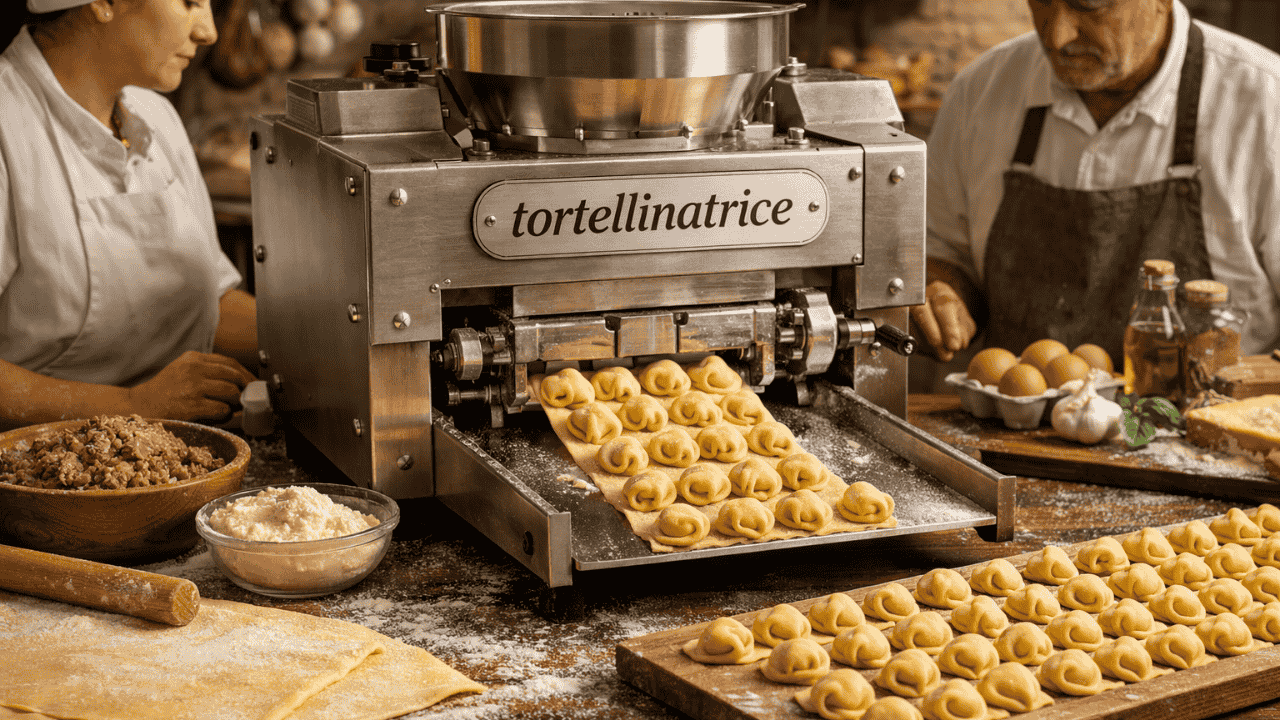
Tortellini have long been a symbol of Italian culinary tradition, representing craftsmanship, patience, and regional identity. As global demand for filled pasta has grown, producers have had to find ways to maintain consistency and efficiency without losing the essence of the product. This need led to the development of specialized machinery, most notably the tortellinatrice. Today, the tortellinatrice plays a central role in both artisanal and industrial pasta production, acting as a bridge between tradition and modern food technology.
What a tortellinatrice is and why it matters
A tortellinatrice is a dedicated machine designed to form tortellini by combining pasta dough and filling into a precise, repeatable shape. While handmade tortellini rely on individual skill and time, this machine automates the shaping and sealing process. The importance of the tortellinatrice lies in its ability to reproduce a complex pasta form at scale while preserving uniformity in size, weight, and filling distribution.
For producers, consistency is not only a matter of appearance but also of cooking performance and customer satisfaction. A well-calibrated tortellinatrice ensures that each piece cooks evenly and meets quality standards batch after batch.
Historical development of tortellini-making machines
The roots of the tortellinatrice can be traced to the mid-twentieth century, when pasta makers began experimenting with mechanical solutions to support growing demand. Early machines were largely mechanical, relying on gears, molds, and manual adjustments. These early versions required skilled operators and frequent maintenance but represented a major step forward from fully manual production.
Over time, technological improvements introduced electric motors, improved materials, and safer designs. Modern versions of the tortellinatrice now incorporate automated controls, allowing producers to fine-tune dough thickness, filling quantity, and shaping speed. This evolution reflects the broader industrialization of food production while still respecting traditional pasta forms.
How a tortellinatrice works in practice
The operation of a tortellinatrice follows a logical and continuous workflow. Pasta dough is first fed into the machine, where it is rolled into thin sheets. At the same time, the prepared filling is guided into a central channel or dosing system.
As the dough sheets move forward, the filling is deposited at regular intervals. The machine then folds the dough around the filling and uses forming molds or rollers to create the classic tortellini shape. Cutting and sealing occur simultaneously, ensuring that each piece is properly closed.
Key functional elements typically include:
- dough feeding and rolling units
- filling distribution mechanisms
- forming and cutting assemblies
- speed and pressure controls
Through this process, the tortellinatrice transforms raw ingredients into finished pasta in a continuous flow.
Different types of tortellinatrice machines
Not all production environments require the same level of automation, which is why several types of tortellinatrice machines exist.
Manual and small-scale machines are often used in artisanal kitchens or specialty shops. These models usually require hands-on operation and produce smaller quantities, making them suitable for businesses that emphasize craftsmanship and customization.
Semi-automatic machines balance efficiency and control. Operators oversee the process but benefit from automated shaping and cutting. This type of tortellinatrice is common in medium-sized pasta laboratories and restaurants.
Fully automatic industrial machines are designed for high-volume production. These systems integrate dough preparation, filling, forming, and output handling. In large factories, a single tortellinatrice can produce thousands of pieces per hour with minimal human intervention.
Advantages of using a tortellinatrice
The adoption of a tortellinatrice offers several operational and quality-related benefits.
First, it delivers consistency. Each tortellino has the same shape, weight, and filling ratio, which is difficult to achieve by hand on a large scale.
Second, it increases production speed. What might take hours of manual labor can be accomplished in a fraction of the time, allowing businesses to meet market demand.
Third, it improves hygiene and safety. Modern machines are built from food-grade materials and designed for easy cleaning, reducing the risk of contamination.
Additional advantages include:
- reduced labor costs
- predictable output volumes
- improved shelf-life uniformity
- easier quality control
These benefits explain why the tortellinatrice has become essential in professional pasta production.
Where tortellinatrice machines are used today
The tortellinatrice is used across a wide range of food production environments. Industrial pasta manufacturers rely on it to supply supermarkets and international markets with packaged tortellini. Restaurants and catering operations use smaller machines to ensure steady output during peak service hours.
Artisan producers also use the tortellinatrice, often adjusting recipes and settings to maintain a handmade appearance while benefiting from mechanical precision. In recent years, even passionate home cooks have shown interest in compact models, reflecting the growing popularity of fresh pasta preparation at home.
Choosing the right tortellinatrice for your needs
Selecting the appropriate tortellinatrice depends on several practical factors. Production capacity is one of the most important considerations. Businesses must evaluate how many kilograms or pieces of tortellini they need to produce per hour.
Automation level is another key factor. Some producers prefer greater manual control, while others prioritize speed and minimal staffing. Space availability, ease of cleaning, and maintenance requirements also influence the decision.
Before investing, it is wise to consider:
- expected daily output
- variety of fillings and dough types
- available technical support
- long-term scalability
A well-chosen tortellinatrice becomes a long-term asset rather than a short-term expense.
Technology and innovation in modern tortellinatrice design
Modern tortellinatrice machines benefit from advances in food engineering and automation. Digital interfaces allow operators to store recipes and adjust settings with precision. Sensors monitor dough flow and filling pressure, helping prevent defects during production.
Energy efficiency has also improved, with newer motors consuming less power while delivering higher performance. Machine designs increasingly focus on sanitation, featuring smooth surfaces and tool-free disassembly for cleaning.
These innovations make the tortellinatrice not only faster but also more reliable and easier to integrate into regulated food production environments.
Cultural significance of the tortellinatrice
While some view automation as a threat to culinary tradition, the tortellinatrice often serves the opposite role. By enabling consistent production, it helps preserve traditional pasta shapes and recipes in a global market. Without such machines, many classic filled pastas would struggle to remain commercially viable.
Producers can still focus on high-quality ingredients and authentic fillings, using the tortellinatrice as a tool rather than a replacement for culinary knowledge. In this way, technology supports tradition rather than erasing it.
Tortellinatrice use beyond industrial settings
The growing interest in fresh pasta has expanded the appeal of the tortellinatrice beyond factories. Culinary schools use these machines for training, allowing students to understand both manual and automated processes. Small-scale models are also appearing in specialty kitchens where chefs want consistency without outsourcing production.
This broader adoption highlights the flexibility of the tortellinatrice and its relevance across different skill levels and production scales.
Conclusion
The tortellinatrice represents a crucial intersection between tradition and innovation in pasta production. From its historical origins to its modern, technology-driven designs, it has reshaped how tortellini are made and distributed. By offering consistency, efficiency, and scalability, the tortellinatrice allows producers to meet growing demand while maintaining quality and authenticity. Whether used in an industrial plant, a restaurant kitchen, or a small artisanal workshop, this machine continues to play a vital role in keeping one of the world’s most beloved pasta forms accessible and reliable.
Frequently Asked Questions
What is the main purpose of a tortellinatrice?
The main purpose of a tortellinatrice is to automate the shaping and sealing of tortellini while maintaining consistent size and filling.
Can a tortellinatrice handle different fillings?
Yes, most machines can be adjusted to work with various fillings, including meat, cheese, and vegetable mixtures.
Is a tortellinatrice suitable for small businesses?
Many models are designed specifically for small or medium operations, making a tortellinatrice suitable for artisanal producers and restaurants.
How does a tortellinatrice improve hygiene?
Modern machines are built with food-grade materials and easy-to-clean components, reducing contamination risks.
Does using a tortellinatrice affect traditional pasta quality?
When properly used, a tortellinatrice supports traditional quality by ensuring uniform cooking and consistent filling without altering recipes.
